
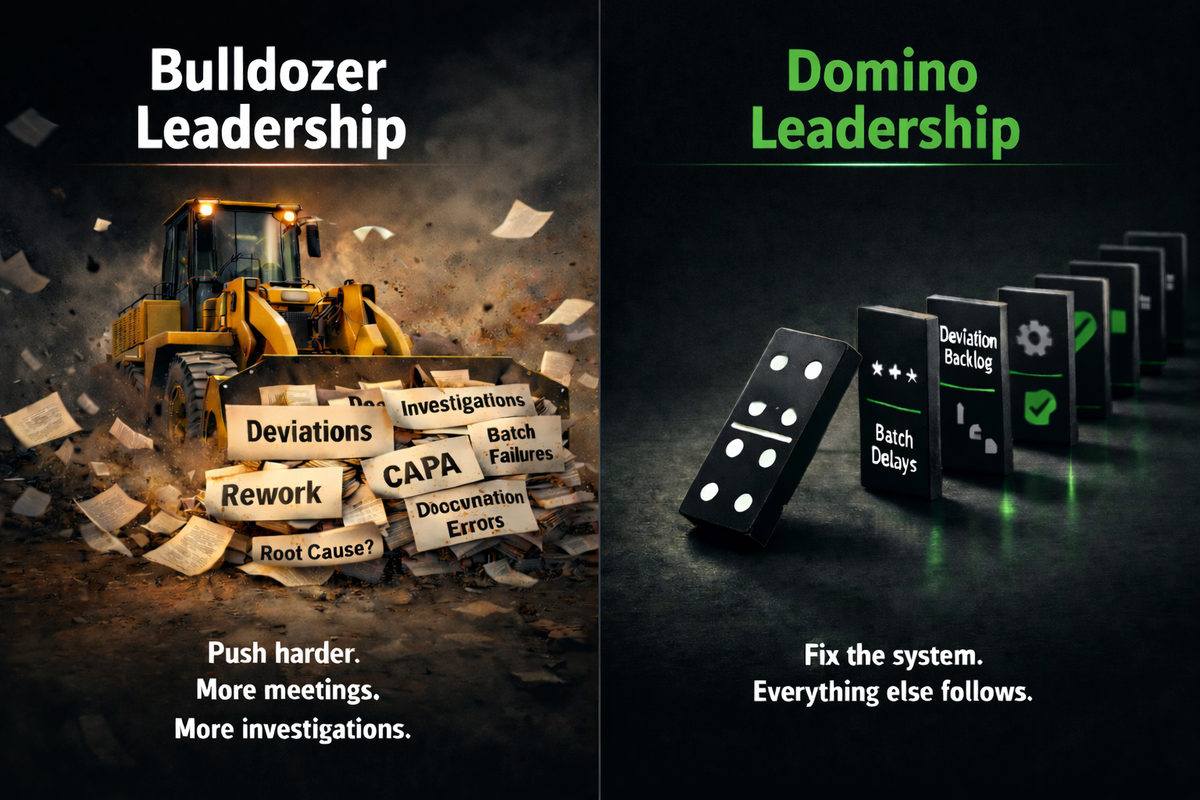
Don’t Start Conversations as a Bulldozer — Start Them as a Domino
In many pharmaceutical manufacturing organizations, operational conversations often begin like bulldozers.
- A problem occurs.
- A batch fails.
- A deviation is opened.
- An audit observation lands.
- Production slips behind schedule.
- The response is immediate and forceful.
- Meetings are scheduled.
- Escalation emails are sent.
- Investigation teams are formed.
- Dashboards are reviewed.
The intent is good. Leaders want to solve the problem quickly.
But bulldozers, by nature, push large amounts of material at once. They move forcefully, loudly, and visibly. In operational environments, this approach often produces activity without structural change.
The problem may be addressed temporarily, but the system that created it usually remains untouched.
Most organizations react to operational problems after they appear—through investigations, meetings, and escalation—but the deeper cost sits inside what quality experts call the Cost of Poor Quality (COPQ): the hidden operational losses created by unstable systems.
Effective operational leadership in manufacturing often begins by identifying the first domino that changes the system.
And so the same conversations repeat themselves weeks or months later.
The Bulldozer Leadership Trap
Bulldozer conversations tend to focus on what just happened.
- Why did the deviation occur?
- Why did the batch fail?
- Why was the investigation delayed?
These are important questions, but they often drive discussions toward symptoms rather than causes.
Teams analyze events, reconstruct timelines, and identify procedural gaps. Corrective actions are written. Documentation is updated.
The organization feels as though progress has been made.
Yet the underlying system frequently stays the same.
The result is what quality professionals often refer to as the Hidden Factory—the quiet accumulation of investigations, rework, documentation corrections, and process interruptions required to keep production moving despite systemic instability.
In many pharmaceutical operations, this hidden factory can consume 20–40% of revenue.
Bulldozers create motion.
They rarely create transformation.
The Domino Approach
Great operational leaders start conversations differently.
Instead of approaching problems like bulldozers, they approach them like dominos.
A single domino appears small and insignificant. On its own, it seems incapable of moving much.
But when placed carefully within a system, the first domino can trigger a chain reaction that moves far more than brute force ever could.
The goal is not to push harder.
The goal is to identify the first domino that changes the system.
Finding the First Domino
Consider a common scenario.
A site struggles with deviation backlog. Investigations remain open for months, batch release timelines slip, and quality teams become overwhelmed.
A bulldozer conversation might begin with questions like:
- Why are investigations taking so long?
- Why aren’t teams closing deviations on time?
- Why aren’t procedures being followed?
These questions may produce answers, but they rarely expose the structural issue.
A domino conversation asks a different question:
Where in the system does this problem actually begin?
Sometimes the answer is surprisingly simple.
Perhaps batch status visibility is fragmented across spreadsheets and email chains. Operators, quality reviewers, and planners do not share the same real-time understanding of batch progress. When something goes wrong, the issue is discovered late, forcing a deviation investigation rather than enabling an early correction.
The deviation backlog is not the first domino.
It is the last domino.
The first domino might be something much earlier in the process—how work is tracked, how visibility is shared, or how decisions are triggered.
When the first domino falls, multiple downstream problems disappear at once.
Why Domino Leadership Works
Domino leadership aligns naturally with several well-known operational frameworks.
LEAN thinking focuses on eliminating systemic waste rather than addressing isolated events.
Theory of Constraints teaches that improving the wrong part of a system produces little overall gain.
Quality cost analysis reveals that internal failure costs—rework, investigations, and delays—often dominate operational losses.
In each case, the principle is the same.
Small structural corrections can produce disproportionately large improvements.
The challenge is identifying where to begin.
The Leadership Shift
Many organizations assume leadership requires pushing harder when problems arise.
More meetings.
More reporting.
More oversight.
But effective operational leadership often requires the opposite approach.
Instead of pushing harder, leaders must step back and ask:
What is the smallest change that could remove this entire category of problems?
That question is rarely loud.
It rarely creates urgency.
But it often reveals the first domino.
The Quiet Power of the First Domino
When the right domino falls, the results can appear almost effortless.
Deviation investigations decline because issues are detected earlier.
Batch release accelerates because documentation errors decrease.
Production stability improves because teams operate with shared visibility.
None of these improvements require bulldozers.
They require placing the right domino in the right position.
A Final Thought
Bulldozers move a lot of earth.
They are powerful, visible, and sometimes necessary.
But when it comes to fixing complex operational systems, brute force rarely solves the underlying problem.
Dominos are quieter.
Smaller.
Less dramatic.
Yet when placed correctly, a single domino can move an entire system.
The real challenge for operational leaders is learning where to place the first one.
Understanding where the first domino sits inside your operation is often the hardest part.
If you're interested in learning more about how systemic instability drives operational losses, explore our guide on the Cost of Poor Quality in pharmaceutical manufacturing.
Tags
Related Posts

What Is the Cost of Poor Quality in Pharmaceutical Manufacturing?
Cost of Poor Quality (COPQ) represents the hidden financial losses created when pharmaceutical manufacturing systems fail to execute consistently. While many sites track deviations, investigations, and batch failures, few translate those operational issues into financial impact. In many pharmaceutical organizations, COPQ quietly represents 25–40% of operational cost. Understanding where those losses originate is the first step toward restoring execution stability and recovering lost manufacturing capacity.

Exposing the Hidden Factory: How COPQ Reveals Capacity Constraints
The Hidden Factory represents unmeasured capacity consumed by internal failure activities such as deviation investigations, production rework, and documentation errors. While these activities are tracked operationally, their economic impact is rarely quantified. Applying the Cost of Quality framework translates this consumption into financial terms, providing a basis for capacity recovery and risk-informed prioritization aligned with ICH Q9 and Q10.

How to Calculate Your Facility's True COPQ (Free Calculator)
Cost of Poor Quality (COPQ) can quietly erode margins in biopharma operations through rework, deviations, delays, and batch losses. This post breaks down the four key components of quality cost—prevention, appraisal, internal failure, and external failure—and introduces a free COPQ calculator to help you estimate the true financial impact and identify opportunities for ROI.