
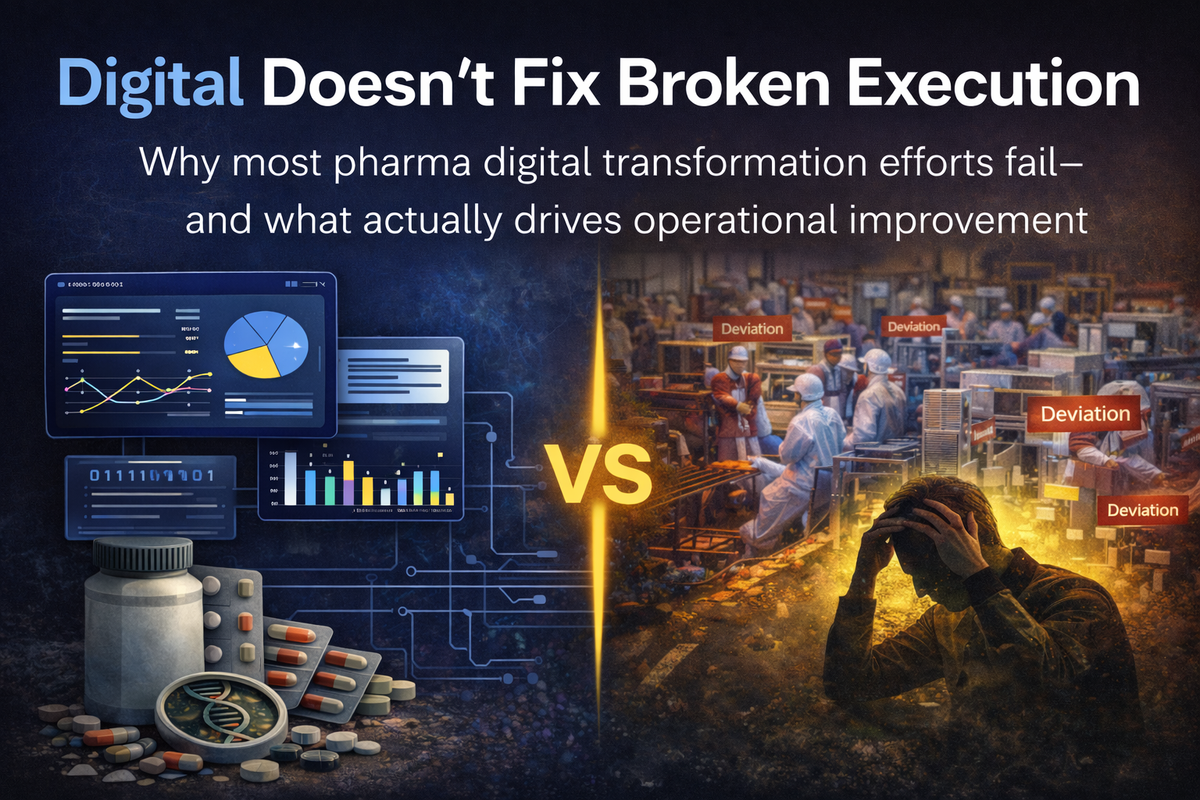
Digital Doesn’t Fix Broken Execution
Pharmaceutical companies are not underinvesting in digital.
They are over investing in it—relative to what actually drives operational outcomes.
MES upgrades. Data platforms. Dashboards. AI-driven analytics.
The expectation is consistent:
Better visibility will lead to better execution.
It doesn’t.
Because digital doesn’t fix broken execution.
Yet the outcomes rarely change.
- Batch failures persist
- Deviation backlogs grow
- Disposition timelines remain unpredictable
Not because the technology is insufficient.
But because of what it is being asked to fix.
The False Assumption
Most digital transformation programs are built on a premise that sounds logical but often fails in practice:
If we improve visibility, execution will improve.
In pharmaceutical manufacturing, that assumption breaks down quickly.
- Visibility does not create control
- Dashboards do not make decisions
- Data does not enforce discipline
- Digital systems provide awareness
- Awareness without action is not execution
Digital transformation doesn’t fail because of technology. It fails because instability gets scaled.
And awareness, without a structured way to act on it, produces observation not improvement.
Digitizing Instability
When digital programs fail, they fail in a consistent and predictable way.
They digitize instability.
Broken workflows become digitized workflows.
Deviation tracking becomes more sophisticated but deviation volume does not decrease.
Delays are measured with precision but not removed.
Inconsistency is scaled across the organization.
This is the fundamental error.
You don’t fix a broken system by making it more visible.
You fix it by changing how it operates.
You cannot digitize your way out of a broken system.
Dashboards vs. Execution
Most digital initiatives are designed to answer one question: What is happening?
But operations typically does not struggle with awareness. It struggles with execution.
The real question is: What should happen next and who is accountable for it?
That requires something dashboards cannot provide:
- Decision clarity
- Prioritization logic
- Ownership of action
Without that layer, digital systems remain observational.
They describe problems in detail.
They do not resolve them.
Where the Money Is Lost
This is not a technology gap—it is a financial one.
The cost of poor execution is embedded in daily operations but rarely measured as a system.
It shows up as:
- Deviation backlogs consuming investigation capacity
- Rework reducing available throughput
- Batch failures eliminating revenue
- Delayed disposition tying up working capital
- Attrition driven by sustained execution friction and lack of decision clarity
Over time, this doesn’t just erode performance—it erodes capability and leadership continuity.
Individually, these are treated as operational issues.
Collectively, they form a financial system of loss.
Often referred to as the Hidden Factory—the work required to correct what should not have occurred.
Digital transformation often makes this hidden factory more visible.
But visibility does not reduce it.
In many cases, it institutionalizes it.
The Missing Layer: Governance
This is where most digital strategies break.
Not at the level of tools but at the level of execution structure.
What is missing is governance.
Not governance as documentation.
Governance as an operating system for decisions.
A system that defines:
- How work is prioritized
- How trade-offs are made
- How escalation is triggered
- How execution ownership is enforced
Without this, data accumulates but does not convert.
Meetings increase.
Reporting improves.
But decisions slow down—and execution fragments.
Without governance, data has nowhere to go.
The Sequence Problem
Digital transformation fails most often because it is implemented out of sequence.
Organizations start with tools instead of systems.
But effective transformation follows a disciplined progression:
- Truth — establish what is actually happening
- Readiness — correct structural instability
- Governance — define how decisions drive execution
- Digital — amplify visibility and reinforce consistency
Most organizations start at step four.
And when they do, they amplify the very conditions they are trying to fix.
More visibility.
Same instability.
What Actually Works
Digital transformation succeeds when it follows execution correction not the other way around.
When workflows are stable, digital tools enhance clarity.
When governance is defined, data drives decisions.
When execution discipline exists, visibility accelerates performance.
This is where digital creates value.
Not as a starting point.
But as a force multiplier.
Extend This Perspective
What’s outlined here is not a technology failure.
It is a pattern of execution instability being scaled through digital systems.
We’ve documented this pattern more fully in our whitepaper:
Digital Doesn’t Fix Broken Execution: Rethinking Transformation in Pharmaceutical Manufacturing
Including:
- The structural drivers of deviation backlogs and delayed disposition
- Why governance—not visibility—is the constraint
- A practical sequencing model for operational recovery
Closing Perspective
Digital doesn’t fix broken execution. It amplifies it.
Pharmaceutical manufacturing typically does not have a digital problem.
It has an execution problem that digital cannot solve on its own.
Until execution is stabilized, digital transformation will continue to produce the same outcome:
- Clearer dashboards. More data. Better reporting.
- Unchanged performance.
Digital does not create discipline—it amplifies it.
Tags
Related Posts

Don’t Start Conversations as a Bulldozer — Start Them as a Domino
Most operational conversations in pharmaceutical manufacturing begin like bulldozers—forceful, reactive, and loud. Effective leaders start them like dominos: small, precise actions that trigger system-wide improvement.

Exposing the Hidden Factory: How COPQ Reveals Capacity Constraints
The Hidden Factory represents unmeasured capacity consumed by internal failure activities such as deviation investigations, production rework, and documentation errors. While these activities are tracked operationally, their economic impact is rarely quantified. Applying the Cost of Quality framework translates this consumption into financial terms, providing a basis for capacity recovery and risk-informed prioritization aligned with ICH Q9 and Q10.

Deviation Backlogs Are Not Linear: Understanding the Hidden Factory in GMP Investigations
Deviation investigations are often managed as a linear workload—one record, one investigation, one unit of effort. This assumption holds only while the system operates within capacity. Once backlog forms, the system behavior changes. Effort no longer scales with the number of deviations; it expands nonlinearly as coordination, prioritization, and aging effects take over. The result is a Hidden Factory—capacity consumed not by resolving deviations, but by managing them. Understanding this shift is critical: restoring performance is not about working harder, but about re-establishing flow in a system that has crossed into exponential cost.