
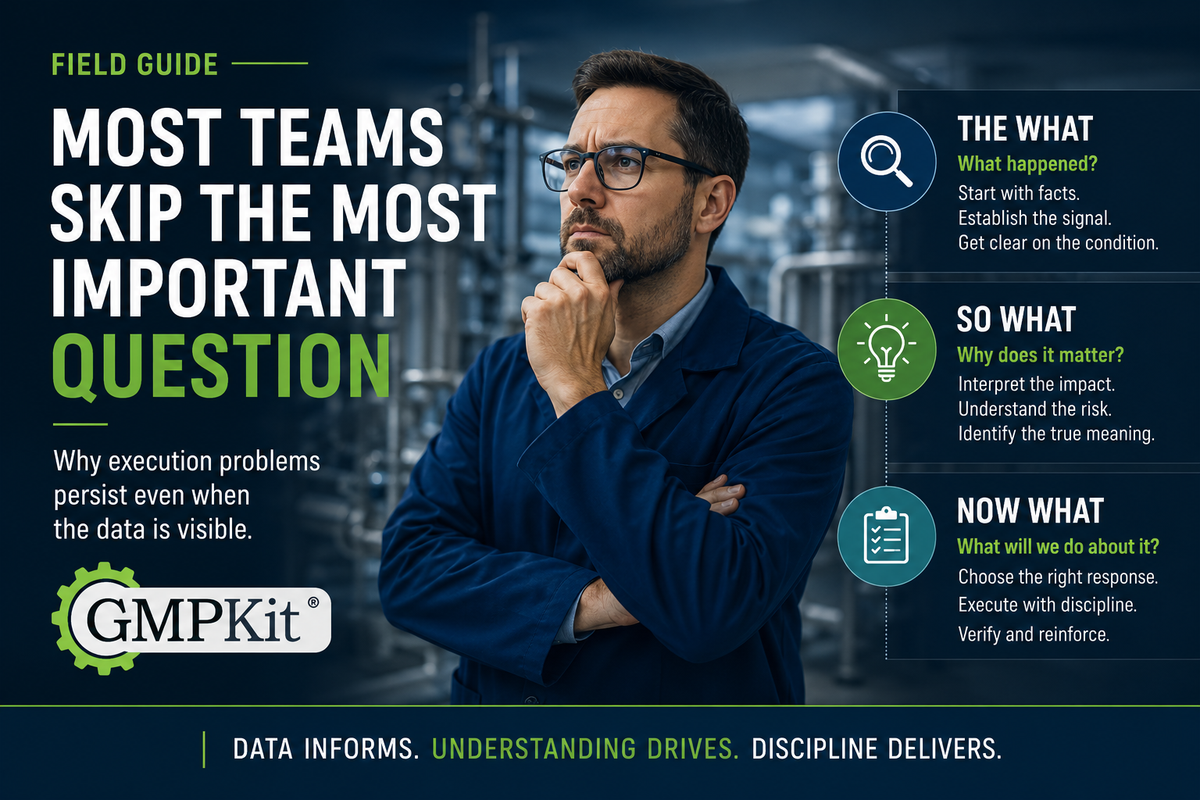
Most Teams Skip the Most Important Question
Why execution problems persist even when the data is visible
In pharmaceutical manufacturing, most organizations are not suffering from a lack of visibility.
They are suffering from a lack of operational understanding.
Teams are surrounded by dashboards, deviation metrics, escalation meetings, CAPAs, batch status trackers, AI discussions, digital transformation initiatives, and endless streams of operational data.
Yet despite all of that visibility, the same problems continue to appear:
- Delayed disposition
- Deviation backlog
- Rework
- Lost capacity
- Execution instability
- Schedule disruption
- Repeated investigations
- Operational firefighting
Because visibility is not the same thing as understanding.
Most organizations can identify problems.
Far fewer can properly interpret them.
And even fewer can translate them into disciplined execution.
That gap matters.
Because that gap is where Cost of Poor Quality (COPQ) grows.
The Industry Has Developed a Dangerous Habit
Most organizations move from:
Observation → Action
far too quickly.
Something happens.
- A deviation is opened.
- A meeting is scheduled.
- A dashboard turns red.
- Action items are assigned.
- A CAPA is generated.
- Leadership asks for updates.
- People begin reacting.
But very little time is spent asking a much more important question:
“So what?”
- What does this actually mean operationally?
- What signal is this event sending?
- What risk does it represent?
- What behavior is it reinforcing?
- What structural weakness does it expose?
- What capacity is being lost because of it?
- What happens if this pattern continues for another 3 months?
Most organizations are overloaded with data because they have not established a disciplined way to interpret operational significance.
So instead, they react.
And reaction is not the same thing as leadership.

The Difference Between Information and Operational Thinking
At GMPKit, we use a simple operational thinking model:
- The What
- The So What
- The Now What
Not because the concepts are complicated.
But because most organizations collapse all three into a single rushed conversation.
The result is predictable:
Teams implement activity before they establish understanding.
And when that happens, organizations often mistake motion for progress.
The What
The “What” is the observable condition.
- The event
- The trend
- The metric
- The deviation
- The delay
- The failure
- The escalation
This is where most organizations spend the majority of their time.
- Collecting information
- Tracking information
- Displaying information
- Discussing information
But information by itself does not improve execution.
A dashboard is not a solution.
A metric is not a strategy.
And visibility alone does not create operational control.
Many organizations have become incredibly sophisticated at displaying problems while remaining ineffective at resolving them.
The So What
This is where operational leadership actually begins.
The “So What” determines operational significance.
This is where organizations establish:
- Why the issue matters
- What business impact it creates
- What risk it introduces
- What capacity it disrupts
- What behavior it reinforces
- What systemic weakness it exposes
- Whether the response should be tactical, structural, or escalated
Two organizations can look at the exact same operational signal and arrive at completely different conclusions.
One treats it as noise.
The other recognizes it as early evidence of execution instability.
That distinction changes everything.
Because without operational interpretation, organizations tend to respond emotionally instead of structurally.
They chase symptoms.
They overload teams with disconnected action items.
They create reporting layers instead of improving execution discipline.
And eventually, the organization becomes exhausted by its own systems.
This is also where many digital transformation efforts begin to fail.
Organizations implement technology before establishing operational meaning.
So instead of amplifying discipline, digital systems simply amplify existing instability.
Technology can accelerate visibility.
But it cannot replace operational judgment.
And AI does not eliminate the need for leadership.
If anything, it increases the importance of disciplined operational interpretation.
The Now What
Only after the “What” and the “So What” are properly understood should organizations move into the “Now What.”
This is where disciplined execution begins.
Not brainstorming.
Not organizational panic.
Execution.
Sequenced action.
Assigned ownership.
Governance.
Decision-making.
Verification.
Escalation.
Reinforcement.
The “Now What” should be proportional to the operational significance established during the “So What.”
Without that foundation, organizations tend to implement activity instead of solutions.
- More meetings
- More trackers
- More reports
- More action items
- More noise
But not necessarily more control.
The strongest operational organizations are not the ones with the most dashboards.
They are the ones capable of translating operational signals into disciplined response.
Why This Matters More Than Ever
The pharmaceutical industry is entering a period where organizations have more access to operational data than ever before.
- AI platforms
- Digital manufacturing
- Integrated systems
- Automated workflows
- Predictive analytics
- Real-time dashboards
But more information does not automatically create better execution.
In many cases, it simply increases the speed at which organizations react.
That is dangerous.
Because speed without interpretation often creates instability at scale.
The organizations that will outperform over the next decade will not simply be the most digital.
They will be the most operationally disciplined.
The ones capable of:
- Establishing operational truth
- Determining significance
- Prioritizing effectively
- Governing consistently
- And executing with structure
That is where sustainable performance lives.
The Bottom Line
Most organizations do not have a visibility problem.
They have a translation problem.
They can see the signal.
But they struggle to determine:
- what it means,
- why it matters,
- and what disciplined response should follow
That gap is where COPQ grows.
And it is also where operational leadership matters most.
Before asking:
“What are we going to do about it?”
organizations should first ask:
“What does this actually mean?”
Because the quality of the response will always depend on the quality of the understanding that came before it.
Call to Action
If your organization is experiencing recurring deviation backlog, delayed disposition, execution instability, or operational friction, start by quantifying the impact.
Run the COPQ Calculator.
Then ask the harder question:
“So what?”
Because identifying the problem is only the beginning.
Translating it into disciplined execution is where operational recovery actually starts.
Running a COPQ calculation is not the finish line.
It is the beginning of the “So What.”
The number alone does not improve execution.
The real value comes from determining:
- What operational behaviors are creating the loss - What systemic friction is sustaining it - And what disciplined response should follow
Because identifying the cost is only the beginning.
Translating it into operational recovery is the real “Now What.”
After running the COPQ Calculator, contact GMPKit to help your organization determine the “So What” and build the disciplined “Now What” required for operational recovery.
Tags
Related Posts

Dashboards Don’t Stop Debris
Dashboards were never meant to be decorative. The original dashboard existed to stop debris before it reached the passenger. Modern business dashboards do the opposite — they measure the mess after it hits. In pharmaceutical manufacturing, that mess shows up as lost batches, deviation backlog, delayed disposition, and rework — the true drivers of Cost of Poor Quality. Visibility alone does not prevent failure. Structural correction does.

You Ran the COPQ Calculator—Now Lead the Response.
Visibility doesn’t fix execution. It exposes it. The COPQ calculator makes the cost visible—but visibility alone doesn’t change outcomes. Leadership action does. What comes next determines whether this remains a number—or becomes a turning point.

Exposing the Hidden Factory: How COPQ Reveals Capacity Constraints
The Hidden Factory represents unmeasured capacity consumed by internal failure activities such as deviation investigations, production rework, and documentation errors. While these activities are tracked operationally, their economic impact is rarely quantified. Applying the Cost of Quality framework translates this consumption into financial terms, providing a basis for capacity recovery and risk-informed prioritization aligned with ICH Q9 and Q10.