
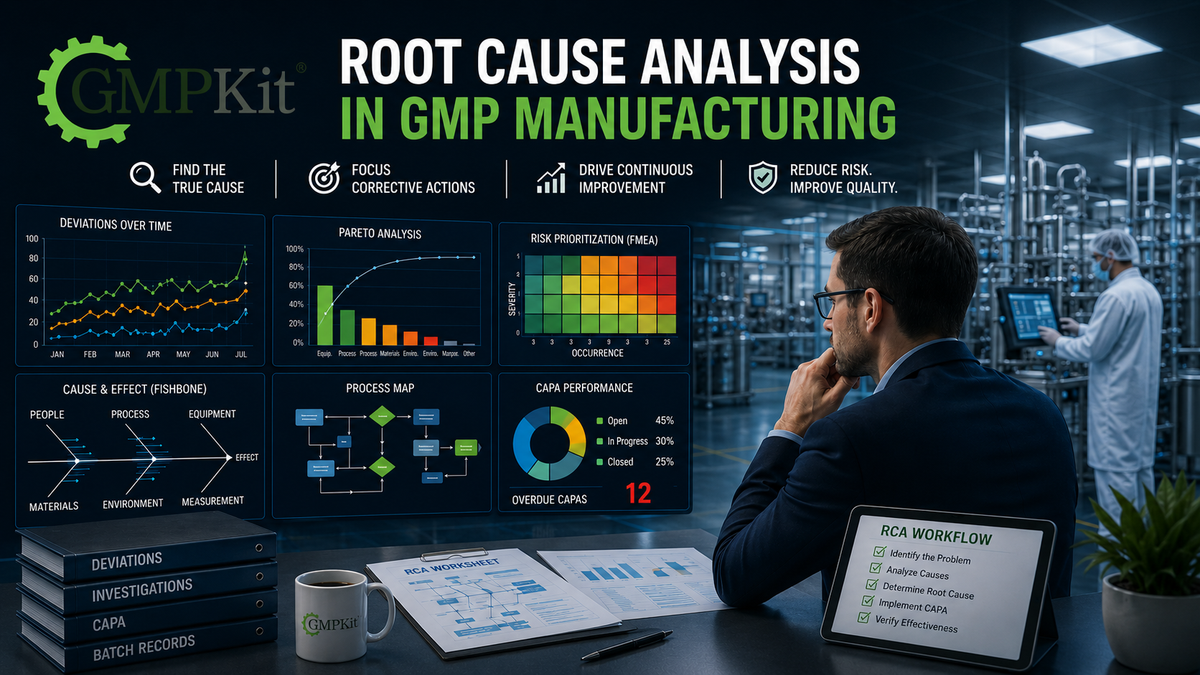
Root Cause Analysis Tools for GMP Manufacturing: 12 Proven Methods for Better Investigations
Root Cause Analysis Tools for GMP Manufacturing: 12 Proven Methods for Better Investigations
In pharmaceutical manufacturing, solving problems quickly is important. Solving the right problem is critical.
Organizations often spend significant time addressing symptoms while the underlying causes remain unresolved. The result is recurring deviations, ineffective CAPAs, prolonged investigations, missed production targets, and increasing Cost of Poor Quality (COPQ).
Root Cause Analysis (RCA) provides a structured approach to identifying the true source of a problem so corrective actions can be targeted where they will have the greatest impact.
This article reviews twelve commonly used root cause analysis tools and explains how they can be applied within GMP manufacturing environments.
Why Root Cause Analysis Matters in GMP Manufacturing
Effective root cause analysis supports:
- Deviation investigations
- CAPA development
- Audit and inspection readiness
- Batch failure investigations
- Cost of Poor Quality (COPQ) reduction
- Operational performance improvement
- Continuous improvement programs
When performed effectively, RCA helps organizations move beyond immediate containment activities and address systemic issues that contribute to recurring problems.
1. The 5 Whys
The 5 Whys technique is one of the simplest and most widely used RCA methods.
The process involves repeatedly asking "Why?" until the underlying cause becomes apparent.
Before beginning a root cause analysis, organizations should ensure the problem is clearly defined. A poorly written problem statement often leads investigations toward symptoms rather than underlying causes. Check out our article titled "How To Write the Perfect Problem Statement."
Example
Problem:
A batch disposition was delayed.
Why?
QA review was delayed.
Why?
The investigation was incomplete.
Why?
Required information was missing.
Why?
Production documentation was inconsistent.
Why?
There was no standardized documentation process.
Root Cause:
Lack of standardized documentation practices.
Best Used For
- Simple deviations
- Process breakdowns
- Escalation investigations
- Initial problem screening
2. Fishbone Diagram (Cause-and-Effect Diagram)
The Fishbone Diagram, also known as the Ishikawa Diagram, organizes potential causes into categories.
Common GMP categories include:
- People
- Process
- Equipment
- Materials
- Environment
- Measurement
Best Used For
- Cross-functional investigations
- Complex manufacturing deviations
- CAPA workshops
- Team-based problem solving
3. Cause and Effect Matrix
A Cause and Effect Matrix evaluates potential process inputs against desired outputs to identify variables most likely contributing to a problem.
Best Used For
- Process optimization
- Yield improvement
- Scale-up activities
- Risk prioritization
4. Pareto Analysis
Pareto Analysis applies the 80/20 principle to identify the small number of causes responsible for the majority of problems.
Example:
A site discovers that 75% of deviations originate from only three manufacturing processes.
Best Used For
- Deviation trending
- CAPA prioritization
- COPQ analysis
- Resource allocation
5. Process Mapping
Process mapping visualizes workflow steps and decision points to identify breakdowns and inefficiencies.
Best Used For
- Batch record review processes
- Material release workflows
- Deviation management systems
- Technology transfers
6. SIPOC Diagram
SIPOC stands for:
- Suppliers
- Inputs
- Process
- Outputs
- Customers
SIPOC diagrams provide a high-level view of a process before detailed investigation begins.
Example
For batch disposition:
- Supplier → Manufacturing
- Input → Batch documentation
- Process → Review and approval
- Output → Released batch
- Customer → Supply chain and patient
Best Used For
- Investigation planning
- Process definition
- Cross-functional alignment
7. DMAIC
DMAIC is the core Six Sigma improvement methodology:
- Define
- Measure
- Analyze
- Improve
- Control
DMAIC provides a structured framework for investigating and solving recurring operational challenges.
Best Used For
- Chronic deviation issues
- Performance improvement programs
- Large-scale operational initiatives
DMAIC is often used alongside process mapping, SIPOC diagrams, and trend analysis to address recurring operational issues. Organizations managing chronic deviation backlogs frequently use DMAIC to identify systemic causes rather than addressing individual events in isolation.
Organizations experiencing significant investigation backlogs often discover that recurring issues share common systemic causes. Check out our article titled "Deviation Backlogs Are Not Linear."
8. Fault Tree Analysis (FTA)
Fault Tree Analysis begins with a failure event and works backward through logical pathways to identify contributing causes.
Best Used For
- Critical quality events
- High-risk systems
- Equipment failures
- Risk assessments
9. Plan-Do-Check-Act (PDCA)
PDCA is a continuous improvement cycle used to test and refine solutions.
- Plan
- Do
- Check
- Act
Best Used For
- CAPA effectiveness checks
- Continuous improvement
- Operational excellence initiatives
10. Trend Analysis
Trend analysis evaluates historical data to identify recurring patterns and emerging risks.
Examples include:
- Deviation aging trends
- Investigation cycle times
- Batch review delays
- CAPA closure performance
Best Used For
- Management review
- Inspection readiness
- Quality system health assessments
11. Barrier Analysis
Barrier Analysis identifies controls that should have prevented an event and evaluates why they failed.
Best Used For
- Human error investigations
- Process failures
- Compliance events
- Repeat deviations
12. Failure Modes and Effects Analysis (FMEA)
FMEA proactively identifies potential failures before they occur.
The methodology evaluates:
- Severity
- Occurrence
- Detectability
Organizations use FMEA to prioritize risk reduction activities and improve process robustness.
Best Used For
- Risk management
- Process design
- New product introduction
- Technology transfer activities
Which Root Cause Analysis Tool Should You Use?


Common Root Cause Analysis Mistakes
Many organizations struggle with RCA not because they lack tools, but because they misuse them.
Common mistakes include:
- Confusing symptoms with root causes
- Stopping investigations too early
- Focusing solely on human error
- Implementing CAPAs without addressing systemic issues
- Failing to verify effectiveness
The most effective investigations combine multiple tools rather than relying on a single methodology.
Root Cause Analysis Tools Are Most Effective When Used Together
One of the most common mistakes in GMP investigations is attempting to force every problem through a single methodology. A 5 Whys exercise may be sufficient for a simple documentation error, while a complex recurring deviation may require a combination of Process Mapping, Fishbone Analysis, Trend Analysis, and FMEA.
Effective investigations often begin broadly and progressively narrow toward the most probable root causes. The goal is not to complete a tool—it is to understand the system that allowed the problem to occur.
How GMPKit Approaches Root Cause Analysis
At GMPKit, root cause analysis is integrated into deviation investigations, CAPA effectiveness programs, batch recovery efforts, inspection readiness activities, and operational performance improvement initiatives.
While many organizations rely on a single RCA tool, we have found that the most effective investigations combine multiple methodologies. Fishbone (Ishikawa) analysis often serves as the foundation for identifying potential causes across people, process, equipment, materials, measurement, and environmental factors, while complementary tools such as 5 Whys, Process Mapping, Trend Analysis, and FMEA help investigators further explore and prioritize potential causes.
Most importantly, we view potential causes as hypotheses rather than conclusions. Effective investigations require documented evidence, objective evaluation, and a disciplined approach to determining which causes can be confirmed, which can be ruled out, and which require further analysis.
Rather than treating investigations as isolated quality events, we evaluate the broader operational system, including governance structures, prioritization methods, execution discipline, process design, and organizational behaviors. In many cases, recurring deviations are symptoms of governance failures rather than technical failures.
We also leverage root cause analysis principles during scale-up and operational readiness initiatives. Many scale-up delays are attributed to equipment or process limitations when the actual bottleneck resides elsewhere within the system. By applying structured RCA methodologies, organizations can identify constraints affecting throughput, execution, quality performance, and schedule adherence before they become barriers to successful commercialization.
For a deeper discussion on this concept, see our article on Quality System Governance Archetypes.
This philosophy forms the foundation of the GMPKit Investigation Blueprint™, a structured approach designed to improve investigation quality, strengthen CAPA effectiveness, and reduce recurring deviations.
Frequently Asked Questions
What is the most common root cause analysis tool?
The 5 Whys is one of the most widely used RCA tools because it is simple to apply and requires minimal preparation. However, complex GMP investigations often require additional tools such as Fishbone Diagrams, Process Mapping, or FMEA.
What root cause analysis tool is best for GMP deviations?
There is no single best tool. Many organizations use a combination of 5 Whys, Fishbone Diagrams, Trend Analysis, and Process Mapping depending on the complexity of the deviation.
What is the difference between CAPA and Root Cause Analysis?
Root Cause Analysis identifies why a problem occurred. CAPA defines the corrective and preventive actions used to address the identified causes and prevent recurrence.
The Bottom Line
Root cause analysis is not about finding someone to blame. It is about understanding why a problem occurred and implementing sustainable solutions that prevent recurrence.
Whether using 5 Whys, Fishbone Diagrams, DMAIC, SIPOC, or FMEA, the objective remains the same: identify the true cause, eliminate it, and improve the performance of the overall system.
How Much Are Recurring Deviations Costing Your Organization?
Root cause analysis is most effective when it addresses the underlying operational issues driving recurring deviations, prolonged investigations, batch delays, and CAPA inefficiencies.
Many organizations underestimate the financial impact of these issues. Understanding the full Cost of Poor Quality (COPQ) can help organizations quantify the impact of recurring deviations, prolonged investigations, and batch delays. For further insight check out our article titled "What Is the Cost of Poor Quality in Pharmaceutical Manufacturing?"
Use the GMPKit Cost of Poor Quality (COPQ) Calculator to estimate the potential financial impact of recurring operational and quality challenges within your organization.
Struggling with Recurring Deviations or Investigation Backlogs?
Root cause analysis tools are only effective when supported by the right governance, prioritization, and execution systems. If your organization is experiencing recurring deviations, aging investigations, CAPA effectiveness challenges, or batch disposition delays, GMPKit can help.
Our team specializes in operational diagnostics, deviation backlog reduction, CAPA effectiveness, inspection readiness, and operational performance improvement for GMP manufacturing organizations.
Tags
Related Posts

Stop Writing GMP Deviation Investigations. Start Building Them.
A GMP deviation management framework for manufacturing, supply chain, and engineering teams. Higher quality investigation reports with faster delivery. Speed and quality feel like they pull in opposite directions — until you treat a deviation investigation as a project to build, not a document to write.

How to Calculate Your Facility's True COPQ (Free Calculator)
Cost of Poor Quality (COPQ) can quietly erode margins in biopharma operations through rework, deviations, delays, and batch losses. This post breaks down the four key components of quality cost—prevention, appraisal, internal failure, and external failure—and introduces a free COPQ calculator to help you estimate the true financial impact and identify opportunities for ROI.

Quality System Governance Archetypes: The Faucet, the Sink, and the Drain
Many GMP governance meetings are overloaded with metrics but starved for operational clarity. Today's GMPKit Field Guide article introduces a simple stock-to-flow model—the faucet, sink, and drain—to help pharmaceutical operations and quality leaders identify hidden backlog formation, predict system saturation earlier, and transform Quality System KPI review from administrative reporting into operational control.